Small ag agreements could help stalled global trade talks
January 28, 2013 | 12:05 AM
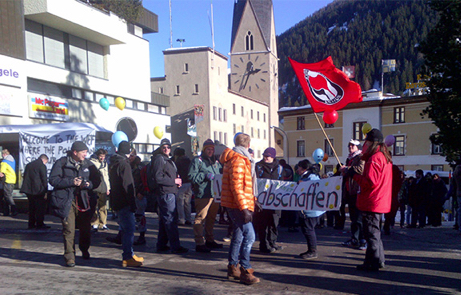 The World Economic Forum in Davos, Switzerland, an annual meeting of financial and political leaders from around the world, attracted a few hundred protesters this weekend. One of the signs said, “Welcome to the WEF where the politicians sell our future to the economy.” (Jerry Hagstrom/The Hagstrom Report)
DAVOS, Switzerland — Agriculture has often been blamed for the failure to finish the Doha Round of multilateral trade negotiations, but small agreements on agriculture may play a role in determining whether the long-stalled round can be saved, trade ministers signaled here in a meeting after they attended the World Economic Forum.
The agriculture deals under consideration would be on tariff rate quota administration and food security, a participant in the talks told The Hagstrom Report.
But any agricultural deals would be secondary to an attempt to reach agreement on trade facilitation, the procedures and controls governing the movement of all goods across national borders, the participant said.

The ministers who attended the World Economic Forum, the famed gathering of the world’s economic elite, met in a separate session organized by Swiss Economics Minister Johann Schneider-Ammann.
After the meeting, Schneider-Ammann told reporters that the ministers “gave a strong signal that they want to see a set of substantial results” at the Bali meeting this December, a meeting of all the trade ministers of the World Trade Organization countries.
He said the ministers meeting in Davos “expressed their readiness” to work on a deal that would include “an agreement on trade facilitation, some issues related to agriculture, as well as additional measures of special interest to developing and in particular least developing countries.”
Trade ministers of the countries belonging to the WTO have been frustrated for years that they have been unable to conclude the Doha Round that was launched in Doha, Qatar, in 2001. That meeting followed the failure in Seattle in 1999 to launch a new trade round.
The Doha meeting took place shortly after the Sept. 11, 2001, terrorist attacks in New York, and there was hope of worldwide cooperation to improve economies in both developed and developing countries through freer trade.
But between the rise of China and the Great Recession, the world has changed a lot since then and agreement has not been reached.
At the meeting here, ministers said it would be necessary for the ambassador to the WTO in Geneva and the WTO staff to move quickly if agreements are to be presented to the ministers in Bali in December.
“We need to have clarity on the scope of a possible deal as soon as possible,” Schneider-Ammann said. “Around Easter we should evaluate and take stock of where we are and whether we will be able to reach a meaningful result in Bali.”
But there is also some concern that ministers might be so tired of the Doha round that they would declare this mini-agreement enough to consider the round completed. “All of us stressed that a success in Bali should not be seen as the end of the Doha road. It should be considered as a stepping stone on the way to address the remaining issues under the WTO agenda including the conclusion of the Doha round,” Schneider-Ammann added.
The WTO member ambassadors in Geneva who make up the Doha Round agriculture negotiating committee met January 18 to consider whether any elements of the December 2008 Doha Round text could be put forward early. However, they appear to have avoided use of the term “early harvest,” which was used earlier in the negotiations and has become an objectionable phrase to U.S. cotton growers and others who believe the round should be completed all at one time.
At that meeting, the G-20 countries led by Brazil suggested consideration of a proposal for tighter disciplines on tariff rate quotas — duties for quantities inside the quotas are lower than quantities outside — so that the way they are managed does not obstruct trade.
At the same meeting, the G-33 countries led by Indonesia suggested consideration of a proposal for extra special treatment to protect poor farmers that would loosen disciplines on domestic support, including public stockholding in order to enhance food security.
The two agriculture proposals are considered as needed to balance the trade facilitation proposal, according to the Geneva-based International Center for Trade and Sustainable Development.
Some trade experts see the improvements to border procedures that would come with trade facilitation as advantageous to the developed countries, which have pushed the developing countries for years to allow goods to enter their countries more quickly and to reduce corruption in ports and airports.
The developed countries have argued that the ultimate beneficiaries would be the people of the developing countries who would get imported goods more easily and cheaper.
John Adank, the New Zealand ambassador to the WTO who chairs the agriculture negotiations, said last week it would be important to “intensify” the negotiating process in the next few weeks.
Michael Punke, the U.S. ambassador to the WTO and a deputy U.S. trade representative, told The Hagstrom Report in an interview last week in Geneva that there could be advantages for the United States if tariff rate quota administration is tightened up.
“We have offensive interests that could be helped by great transparency,” Punke said.
Whether a mini package is “doable” in time for Bali is unclear, he said, adding that Doha has dragged on so long that the negotiators’ credibility is on the line to produce something for the trade ministers to consider seriously at the December meeting.
