WTO Profile: Ahman Hindawi, Jordan
February 05, 2013 | 05:51 PM Filed in: WTO Profiles
Editor’s note: Today we continue bringing you profiles of the nine candidates to become the World Trade Organization’s next director-general. The candidates presented themselves to the WTO General Council and the media last week in Geneva. The profiles will continue this week.
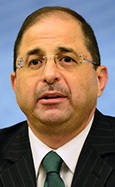 Ahman Thougan Hindawi
GENEVA — Ahmad Hindawi, a Jordanian government official for most of the past 25 years, told the World Trade Organization General Council and the media last week that the issues facing the WTO are the conclusion of the Doha Round and internal reform.
“No one can afford a failed Doha Round,” Hindawi told reporters when asked about the business community’s loss of interest in the round. The potential increase in trade is too great, he added.
“The key challenge facing it is political as many correctly perceive it,” Hindawi said. “Should new trade liberalization prioritize market access or prioritize implementation and development? It is a matter of leadership, choice and commitment.”
Hindawi also participated in Jordan’s negotiations with the United States for the free trade agreement between the two countries, and described the experience of being a small country official working with a giant sophisticated country.
“The negotiations were not easy, but were fair,” he said. “They allowed for the interests of both to be taken into account.”
Before these negotiations, Hindawi said, Jordan had not harmonized many of its technical regulations standards with other countries. But after the agreement with the United States, he said, Jordan eventually harmonized with all of them.
He said he would bring to the job his educational background and also his public and private sector experience in management, which would help with internal reforms.
Hindawi earned a bachelor’s degree in aeronautical engineering from Purdue University in Indiana and a master’s degree in industrial engineering and management from the University of Jordan, as well as a doctoral degree in manufacturing engineering/ management from Birmingham University in the United Kingdom. He was a high-ranking economics official in the Jordanian government from 1989 to 2005, and minister of industry and trade from 2004 to 2005.
Hindawi “developed and oversaw the implementation of economic policies that excelled Jordan’s economic liberalization and integration into the world economy, as well as significantly advancing Jordan’s trade and industry sectors,” according to his official biography.
This included the amendment of many Jordanian laws and development of new ones to ensure compatibility with WTO requirements, including competition, intellectual property, anti-dumping and safeguard laws and regulations. He also played a role in Jordan’s accession to the WTO, the signing of a European Partnership Agreement and the Arab Great Free Trade agreement, as well as the free trade agreement with the United States.
In 2006, Hindawi established a regional management consultancy firm, Hindawi Excellence Group (HEG), operating from Dubai, United Arab Emirates. HEG specializes in quality management, strategic planning, human resources management and development, process management, financial management and related fields for government and private sector clients.
Hindawi also chaired the executive committee of SAMA Dubai, an international real estate development company and was a member of the Dubai Holding Group for three years. He has also been on the boards of the Arab Industrial and Mining Organization, Jordan Agency for Economic Development, Jordan Upgrading and Modernization Program, Jordan Export Promotion Corporation, Jordan Industrial Estate Corporation, Natural Resources Authority and Jordan Iron and Steel Company.
His firm has been “devoted to organizational reform,” Hindawi said, noting that he would bring the ability to be neutral, fair and and act as an honest broker between contending parties. He said he understands “the needs and aspirations of developing countries” yet is “fully committed to trade liberalization.”
On the issue of whether the WTO “should honor the unwritten desire of rotation between developed and developing countries for the top WTO position, or we should focus on merits, capabilities, competencies, and qualifications,” Hindawi told the General Council that the candidates are so distinguished that the two methods “do not contradict with each other.”
Hindawi also told the General Council there should be an open debate on whether the system of a “single undertaking” with everything open until the end is the best way to proceed. But when he spoke to reporters, he seemed committed to the single undertaking approach.
“The single undertaking is a core approach,” Hindawi told reporters. “It is a major improvement of the GATT [the General Agreement on Tariffs and Trade, the WTO predecessor organization] a la carte system,” he said. “It allows for linkages.”
Hindawi noted that not all WTO member countries have the technical prowess to trade, adding that one future challenge is to find sustained funding for “aid to trade” programs. He also noted that some advocates have proposed “spinning off that component into a separate entity in order to enhance the effectiveness and efficiency of WTO’s technical assistance functions.”
Such a suggestion can be considered by the General Council in consultations with WTO’s key stakeholders in parallel with sustaining and strengthening the “Aid for Trade” program, he added.
Members of the General Council should “think of innovative ways to streamline the accession process without compromising its effectiveness or creditability,” he said, but he declined to comment when reporters asked him for his views on Iran, Syria and Iraq joining the WTO.
Hindawi said the TWO staff “should be proactive in monitoring trade policy development, alerting members to protectionist trends; similar to what they did during the 2008 financial crises,” he said.
The system of four deputy directors-general to allow for geographic diversity could be reduced to three, with one of them “the most senior, a CEO equivalent who would run the Secretariat and chair respective committees and who would be of opposite development orientation from the [director-general].”
The other two deputies would lead the technical assistance function and engagement with stakeholders and information dissemination, he said.
GENEVA — Ahmad Hindawi, a Jordanian government official for most of the past 25 years, told the World Trade Organization General Council and the media last week that the issues facing the WTO are the conclusion of the Doha Round and internal reform.
“No one can afford a failed Doha Round,” Hindawi told reporters when asked about the business community’s loss of interest in the round. The potential increase in trade is too great, he added.
“The key challenge facing it is political as many correctly perceive it,” Hindawi said. “Should new trade liberalization prioritize market access or prioritize implementation and development? It is a matter of leadership, choice and commitment.”
Hindawi also participated in Jordan’s negotiations with the United States for the free trade agreement between the two countries, and described the experience of being a small country official working with a giant sophisticated country.
“The negotiations were not easy, but were fair,” he said. “They allowed for the interests of both to be taken into account.”
Before these negotiations, Hindawi said, Jordan had not harmonized many of its technical regulations standards with other countries. But after the agreement with the United States, he said, Jordan eventually harmonized with all of them.
He said he would bring to the job his educational background and also his public and private sector experience in management, which would help with internal reforms.
Hindawi earned a bachelor’s degree in aeronautical engineering from Purdue University in Indiana and a master’s degree in industrial engineering and management from the University of Jordan, as well as a doctoral degree in manufacturing engineering/ management from Birmingham University in the United Kingdom. He was a high-ranking economics official in the Jordanian government from 1989 to 2005, and minister of industry and trade from 2004 to 2005.
Hindawi “developed and oversaw the implementation of economic policies that excelled Jordan’s economic liberalization and integration into the world economy, as well as significantly advancing Jordan’s trade and industry sectors,” according to his official biography.
This included the amendment of many Jordanian laws and development of new ones to ensure compatibility with WTO requirements, including competition, intellectual property, anti-dumping and safeguard laws and regulations. He also played a role in Jordan’s accession to the WTO, the signing of a European Partnership Agreement and the Arab Great Free Trade agreement, as well as the free trade agreement with the United States.
In 2006, Hindawi established a regional management consultancy firm, Hindawi Excellence Group (HEG), operating from Dubai, United Arab Emirates. HEG specializes in quality management, strategic planning, human resources management and development, process management, financial management and related fields for government and private sector clients.
Hindawi also chaired the executive committee of SAMA Dubai, an international real estate development company and was a member of the Dubai Holding Group for three years. He has also been on the boards of the Arab Industrial and Mining Organization, Jordan Agency for Economic Development, Jordan Upgrading and Modernization Program, Jordan Export Promotion Corporation, Jordan Industrial Estate Corporation, Natural Resources Authority and Jordan Iron and Steel Company.
His firm has been “devoted to organizational reform,” Hindawi said, noting that he would bring the ability to be neutral, fair and and act as an honest broker between contending parties. He said he understands “the needs and aspirations of developing countries” yet is “fully committed to trade liberalization.”
On the issue of whether the WTO “should honor the unwritten desire of rotation between developed and developing countries for the top WTO position, or we should focus on merits, capabilities, competencies, and qualifications,” Hindawi told the General Council that the candidates are so distinguished that the two methods “do not contradict with each other.”
Hindawi also told the General Council there should be an open debate on whether the system of a “single undertaking” with everything open until the end is the best way to proceed. But when he spoke to reporters, he seemed committed to the single undertaking approach.
“The single undertaking is a core approach,” Hindawi told reporters. “It is a major improvement of the GATT [the General Agreement on Tariffs and Trade, the WTO predecessor organization] a la carte system,” he said. “It allows for linkages.”
Hindawi noted that not all WTO member countries have the technical prowess to trade, adding that one future challenge is to find sustained funding for “aid to trade” programs. He also noted that some advocates have proposed “spinning off that component into a separate entity in order to enhance the effectiveness and efficiency of WTO’s technical assistance functions.”
Such a suggestion can be considered by the General Council in consultations with WTO’s key stakeholders in parallel with sustaining and strengthening the “Aid for Trade” program, he added.
Members of the General Council should “think of innovative ways to streamline the accession process without compromising its effectiveness or creditability,” he said, but he declined to comment when reporters asked him for his views on Iran, Syria and Iraq joining the WTO.
Hindawi said the TWO staff “should be proactive in monitoring trade policy development, alerting members to protectionist trends; similar to what they did during the 2008 financial crises,” he said.
The system of four deputy directors-general to allow for geographic diversity could be reduced to three, with one of them “the most senior, a CEO equivalent who would run the Secretariat and chair respective committees and who would be of opposite development orientation from the [director-general].”
The other two deputies would lead the technical assistance function and engagement with stakeholders and information dissemination, he said.
