More than 8,000 farmers’ markets on USDA registry
August 02, 2013 | 01:19 PM
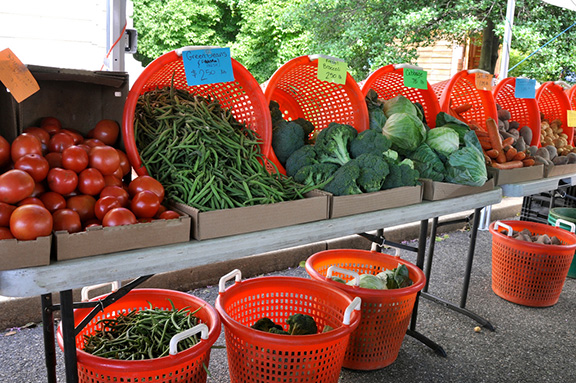 Colorful baskets of produce await customers at the USDA Farmers Market. (USDA/Edward Ragland)
The number of farmers’ markets registered with the Agriculture Department has grown to more than 8,000 around the country, Agriculture Marketing Service Administrator Anne Alonzo will announce on Saturday.
In an exclusive interview with The Hagstrom Report on Thursday, Alonzo said she will announce at a celebration of Farmers Market Week that 8,144 markets have now registered and will be included in USDA’s Farmers Market Directory, which will be updated on the USDA website and can be used, along with an application for hand-held devices, to help consumers find farmers’ markets.
The celebration and announcement will take place at the Columbia Heights Farmers Market at 14th Street and Park Road N.W. at 10 a.m. Agriculture Secretary Tom Vilsack has proclaimed August 4 to 10 National Farmers’ Market Week.

Anne Alonzo
Farmers’ markets provide a sales point for the produce of local farmers and a source of healthy food for consumers, but they also have become “social assembly points, Alonzo said. “They are unifiers in communities.”
“Food is produced and processed and sold in the same region,” she noted. “It stays there and supports the local economy. At the same time it supplies the community with healthy fresh food choices.”
The markets can also be catalysts for economic development, Alonzo said, noting that some farmers and merchants have found so much business that they have opened stores nearby.
When farmers’ markets became popular some years ago, officials “thought a lot of this was a fad,” Alonzo said. “But not only have they not gone away — they are holding and continuing to increase.”
USDA research, she said, shows that there are a growing number of farmers’ markets in food deserts — areas where nutritious food is hard to find. And 3,800 markets, including the one on Fridays in the USDA parking lot, now accept Supplemental Nutrition Assistance Program (SNAP) benefits, also known as food stamps.
USDA recently made $4 million available to help equip farmers’ markets with electronic benefit transfer technology. Last year $16.6 million in SNAP benefits were redeemed at farmers’ markets.
“We want to make sure people can go and utilize farmers’ markets,” Alonzo said. She also praised efforts by Wholesome Wave and others to provide “double bucks” coupons to make fruits and vegetables in farmers’ markets available to low-income people.
“This whole healthy food initiative — farmers’ markets are tailor made for that,” she said.
In the past year the number of farmers’ markets that registered with USDA grew 3.6 percent, Alonzo said. That’s a lower rate of growth than the double-digit growth in recent years, but no one expected those growth rates to be sustained, she said.
“We see a maturation, an evolution and a still-growing farmers’ market movement,” she added.
Perhaps the most interesting statistics coming out of this year’s directory is the growth in certain states.
California still ranks No. 1 in the number of farmers’ markets, and New York is No. 2. Illinois, which had a 15 percent increase in registration, is now No. 3.
Michigan is No. 4, Ohio is No. 5, Pennsylvania is No. 6, Massachusetts in No. 7 and Wisconsin is No. 8.
The number of registered farmers’ markets in Missouri grew 58 percent in the past year and it is now tied with Virginia for No. 9. Iowa and North Carolina are tied No. 10.
The directory is voluntarily updated by market managers, state departments of agriculture marketing associations and others, and there are more farmers’ markets around the country that have not registered, Alonzo noted.
The Obama administration has made a strong commitment to the effort, Alonzo said, because “farmers’ markets play an important part in strengthening local and regional food systems.”
But she also noted that USDA has been using money from previous appropriations to provide assistance to farmers’ markets and that the extension of the 2008 farm bill did not include the Farmers’ Market Promotion Program.
“This underscores the importance of passing a food, farms and jobs bill,” Alonzo said, using a phrase that Vilsack frequently employs. “We need a five-year farm bill. We need that certainty for producers.”
