‘Captain Phillips’ has message about U.S. food aid
October 12, 2013 | 03:24 PM
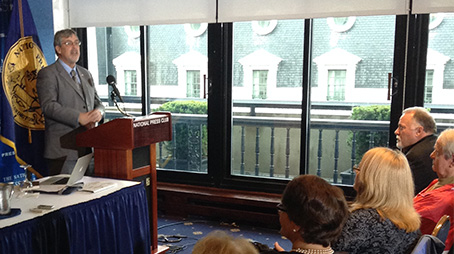 Capt. Richard Phillips talks to reporters Thursday about maritime piracy, recalling the 2009 events behind the new Tom Hanks movie “Captain Phillips,” which opened Friday. (Jerry Hagstrom/The Hagstrom Report)
“Captain Phillips,” the Tom Hanks movie about the pirate capture of a U.S. vessel carrying U.S. food aid bound for African countries, should make Americans think twice about making changes to the U.S. food aid program, a maritime union official said this week at a news conference with Capt. Richard Phillips, whose four-day ordeal is the subject of the film.
“We certainly appreciate President Eisenhower starting the program as Food for Peace” and believe it should be “grown by Americans and moved entirely by Americans,” said Steven Werse, a Merchant Marine captain who is the international secretary-treasurer of the International Organization of Masters, Mates and Pilots.
The merchant vessel Mersk Alabama, captained by Phillips, was carrying U.S. food aid to the ports of Mombasa and Dar Es Salaam to be moved inland to Somalia, Uganda and Rwanda in April 2009 when Somali pirates boarded the ship, starting a confrontation that is the basis of the film.
Werse and Phillips, who used to work together, appeared at the National Press Club newsmaker event Thursday to promote both the movie and the future of the U.S. Merchant Marine, the fleet of civilian commercial vessels that do both private and government work transporting goods around the world.
“We are the truck drivers of the ocean,” Phillips said, before answering the usual celebrity questions about meeting Hanks. Members of the Merchant Marine fight piracy every day, Philips noted before turning the policy issue questions over to Werse.
Under current U.S. law for U.S. food aid programs, food must be purchased in the United States and in most cases shipped in American ships.
A coalition of U.S. humanitarian, farm and shipping groups have supported this system, but some food aid advocates have charged that shipping the food in U.S. ships rather than cheaper foreign vessels wastes money and reduces the amount of food that can be bought with the food aid budget.
Others want to reduce the U.S. food aid budget in favor of providing more money to farmers and others in Third World countries to help them increase production.
The Senate version of the farm bill contains some changes that follow the critics’ views, and the U.S. Agency for International Development has proposed dramatic changes to the food aid program, including buying food from other countries to distribute.
Werse said his union does not believe that food aid money should be given “to a third party to administer,” and questions whether food is available in other countries to use for food aid.
Werse said that continuing the U.S. food aid program is only one element that the U.S. Merchant Marine needs to survive. The Obama administration has proposed cutting several vessels from the Maritime Security Program.
“Unfortunately, we’re under attack. What the pirates could not take away from the captain and his crew, the Congress could take away,” Werse said. “Everyone understands belt-tightening. It’s just that we've had our belt tightened to the point where we could lose our pants,” he said.
- The Maritime Executive — Captain Phillips Tell National Press Club U.S. Maritime Matters
- International Organization of Masters, Mates & Pilots
- U.S. Merchant Marine Academy
- Sony Pictures — “Captain Phillips” Official Site

The container ship MV Maersk Alabama leaves Mombasa, Kenya, on April 21, 2009, two weeks after an attack by Somali pirates who took Capt. Richard Phillips hostage for four days. The cargo included about 5,000 metric tons of U.S. relief supplies bound for Somalia, Uganda and Kenya. (U.S. Navy)


Tom Hanks as Capt. Richard Phillips and a scene from “Captain Phillips,” which opened in movie theaters Friday. (SPE, Inc/Kris Connor)
