Obama to sign farm bill Friday in Michigan after Senate’s 68-32 approval today
February 04, 2014 | 06:00 PM
President Barack Obama will travel to East Lansing, Mich., on Friday and sign the farm bill there after delivering remarks at Michigan State University on the importance of the bill to America’s economy, the White House announced late today.
Michigan is the home state of Senate Agriculture Committee Chairman Debbie Stabenow, a Democrat, who led Senate passage of the bill today of the Agriculture Act of 2014, the conference report that reconciles farm bills passed earlier by the House and Senate.
“The president will see firsthand the research that institutions like MSU are doing to create jobs and drive innovation that benefits farmers, ranchers, our rural communities, and our nation as a whole,” the White House said.
“Following his remarks, the president will sign the Agriculture Act of 2014 into law.”
The House passed the conference report last week, and today’s Senate vote passing the measure 68 to 32 was the last legislative action needed before the farm bill goes to the White House for the president’s consideration.
Earlier today, Obama issued a statement praising the passage.
“Today, in a strong bipartisan vote, the U.S. Senate came together to pass a comprehensive farm bill — legislation that will build on the historic economic gains in rural America over the past five years, create new jobs and opportunities, and protect the most vulnerable Americans,” Obama said in a statement released by his press secretary.
“This bill provides certainty to America’s farmers and ranchers, and contains a variety of commonsense reforms that my administration has consistently called for, including reforming and eliminating direct farm subsidies and providing assistance for farmers when they need it most,” Obama’s statement said.
“It will continue reducing our deficits without gutting the vital assistance programs millions of hardworking Americans count on to help put food on the table for their families. And it will support conservation of valuable lands, spur the development of renewable energy, and incentivize healthier nutrition for all Americans.”
In what may be a reference to the bill’s cut to the Supplemental Nutrition Assistance Program, better known as SNAP or food stamps, which the administration opposed in its budget statements, Obama added, “As with any compromise, the farm bill isn’t perfect — but on the whole, it will make a positive difference not only for the rural economies that grow America’s food, but for our nation.”
Slightly more than two-thirds of the Senate voted for the conference report, a remarkable performance considering the four years it has taken for the bill to develop and the two years of intense conflict with the House of Representatives, where tea party-oriented Republicans objected to the long-standing relationship between farmers and anti-hunger advocates who have been responsible for the enactment of farm bills since the 1960s.
There were marked differences between the Democrats and Republicans in their votes.
Of the 68 senators who voted for the bill, there were 44 Democrats, 22 Republicans and two independents voted for the conference report.
Of the 32 senators who voted against it, there were 23 Republicans and nine Democrats. Most of the votes against the bill appeared to be ideological or in reaction to the cut in the food stamp program, even though it was much lower than what the Republican-controlled House had proposed.
(See link below for The Hagstrom Report Roll Call.)
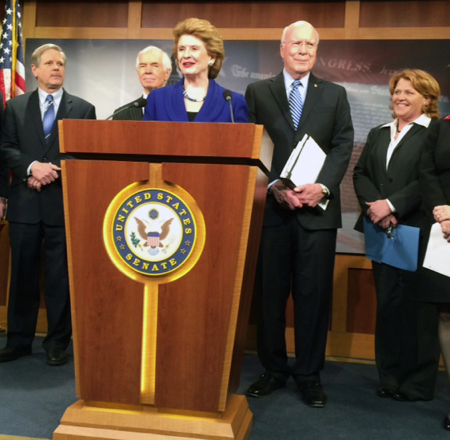
“Well, it’s done,” Senate Agriculture Committee Chairman Debbie Stabenow, D-Mich., told reporters at a post-vote news conference in the Senate Radio-TV Gallery. She was joined by several other senators.
Stabenow stressed the reform in the bill, and that the direct payments that crop farmers have been getting whether prices are high or low are gone.
“You can pay tens of thousands of dollars in crop insurance [premiums] and you’ll never get a dime unless you have a loss,” she said. (Stabenow did not mention that, while farmers do pay premiums, the government pays part of them.)
Stabenow also said all the “harmful” House proposals to cut food stamps had been eliminated and only provisions to improve program integrity remained. She also noted that the bill makes a major new commitment to agricultural research.
Senate Agriculture Committee ranking member Thad Cochran, R-Miss., said the bill “puts our farmers in a position to compete in a worldwide market.”
Sen. Patrick Leahy, D-Vt., a former Senate Agriculture Committee chairman, said, “I have been here for seven of these five-year farm bills, I have never been here for such a roller coaster. Thank goodness Debbie Stabenow was in charge.”
Sen. John Boozman, R-Ark., who had objected to the first version of the commodity title, saying that it did not work for southern agriculture, said, “I want to thank our leadership for working so hard to get this thing done. At the end of the day I think we got a really good product.”
Sen. Amy Klobuchar, D-Minn., pointed out “There is a saying that good things come to those who wait.”
She noted that Minnesota has both farm country and cities and that she sees the interaction between the two. Klobuchar praised the conservation provisions, particularly a “sod-saver” measure aimed at discouraging the plowing up of land and one that is important to hunting and fishing.
Klobuchar added that the completion of the budget and farm bills give her hope that Congress may act on immigration reform.
Both North Dakota senators appeared at the news conference.
Sen. John Hoeven, R-N.D., said that every issue in the bill, including country-of-origin labeling and the commodity title, “was a big-time challenge,” but noted that the bipartisan votes in the House and Senate signaled that the bill “is a good compromise.”
“I was hoping we were going to be here last year, but I’m awfully glad we are here this year,” Hoeven said. “Another extension would have put farmers and ranchers in a very difficult situation.”
Sen. Heidi Heitkamp, D-N.D., also credited the bill’s completion to Stabenow’s “tenacity” and said she hopes that passage means “we are seeing the unraveling of the gridlock that has locked down this body” and that it can be a symbol for the future.
Agriculture Secretary Tom Vilsack was among the first to issue a statement after the bill passed the Senate.
“Today’s action will allow the proud men and women who feed millions around the world to invest confidently in the future,” Vilsack said. “Our communities will have additional support to attract new economic opportunity and create jobs.”
“During difficult times, children, working families, seniors and people with disabilities will have access to nutritious food,” he said. “The potential of new products, treatments and discoveries will be strengthened through new agricultural research. Renewed conservation efforts will protect our fields, forests and waters creating new tourism options. This legislation is important to the entire nation.”
“Building on the historic economic gains in rural America over the past five years, this bill will accomplish those goals while achieving meaningful reform and billions of dollars in savings for the taxpayer,” Vilsack said.
“While no legislation is perfect, this bill is a strong investment in American agriculture and supports the continued global leadership of our farmers and ranchers.”
- The Hagstrom Report — Senate Farm Bill Vote Roll Call
- Agricultural Act of 2014 — Conference Report to Accompany H.R. 2642
- H.R. 2642 — Federal Agriculture Reform and Risk Management Act of 2013
