Concannon addresses Congressional intent on $20 LIHEAP-SNAP program connection
March 25, 2014 | 09:43 PM
By KIM de BOURBON
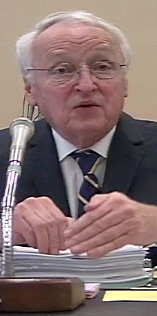
Kevin Concannon, Agriculture undersecretary for food, nutrition and consumer services, told the House Agriculture Appropriations Subcommittee today that if Congress didn’t want states to increase energy assistance payments to food stamp recipients in order to maintain their benefits under the Supplemental Nutrition Assistance Program (SNAP), then Congress shouldn’t have written that standard into the new farm bill.
Subcommittee Chairman Robert Aderholt, R-Ala., and Rep. Kevin Yoder, R-Kan., questioned Concannon on reports that some states have announced they will raise payments under the Low-Income Home Energy Assistance Program (LIHEAP) to $20 a year so that citizens in need of SNAP benefits wouldn’t lose them under the provisions of the new bill.
Aderholt, in his opening question to Concannon, noted news reports that “seven states or more … will be circumventing the intent of Congress to close the loopholes between LIHEAP and SNAP.”
Concannon responded that shortly after the passage of the farm bill, his office sent notices out to states with the language from the bill that specifically referenced the LIHEAP provision, to make sure states followed it.
That statement, he said, “basically said that states, if they were to rely on the LIHEAP provision, would need to spend at least $20 per person per year.”
Concannon emphasized that the letter to the states provided the language of the bill on the $20 provision, not advice.
“We did not urge states to do so and we didn’t urge states to not take advantage of that,” he said.
In response to questions about congressional intent, Concannon said, “These states that have so far elected to put $20 in the LIHEAP are doing so knowing that it will trigger about, on average, $1,000 a year per household. They are doing it out of recognition that families are struggling, and also will have an impact on their respective economy.
“The language in the agriculture bill never said you were prohibited from doing this. It simply said you must spend $20. So states reading that … they said, ‘OK, we’re going to do that $20.’
“If Congress wanted to prohibit it outright, they could have said this is prohibited forevermore, or you have to spend $500, or — pick a steep curve — if Congress had intended to prohibit it.”
Meanwhile, Washington state officials are considering increasing their $1 per year LIHEAP payments to $20 per year per household in order to avoid food stamp cuts, The Seattle Times reported.
In response to questions about reported inefficiencies and errors in the Special Supplemental Nutrition Program for Women, Infants and Children (WIC), Concannon assured the subcommittee that an integrity program last year subjected every state WIC agency to management analysis, and that all of them are “now fully in compliance” with the standard way to assess income eligibilities for the programs.

Rep. Tom Rooney, R-Fla.
Concannon also fielded questions from Rep. Tom Rooney, R-Fla., about the scientific committee advising the USDA on setting new dietary guidelines for 2015.
“I hope it is based on the most recent scientific information available. Is the focus shifting away from nutrition to sustainability and global warming?,” Rooney asked. “Will those recommendations be based on current, solid scientific evidence as we move forward to 2015?”
Rooney said he had heard from beef producers and sugar cane growers in his state about “adverse” things members of the committee had said, such as that meat production is harmful to the environment with manure runoff and methane production by cattle.
He said the scientific advisers should not be dealing in “pie-in-the-sky theories about the perfect world we could all live in someday, but what we’re actually living with today.”
Concannon replied that the committee is in its “very early stages,” and that its focus is to make recommendations on a healthy, safe and nutritious diet.
“The ultimate recommendations in the final report must meet rigorous evidence standards,” he said. “Not just an occasional article here and there, but systematically reviewed.”
He also noted that “the role of the advisory committee is advisory,” and that the Department of Health and Human Services and USDA will make the final determination what the final recommendation of the committee will be.
▪ Rep. Aderholt opening statement ▪ Kevin Concannon written testimony ▪ (Video) Budget hearing ▪ The Seattle Times — State may boost heating assistance to dodge cuts in food stamps
