Kass: White House garden not certified organic
April 22, 2014 | 10:00 PM
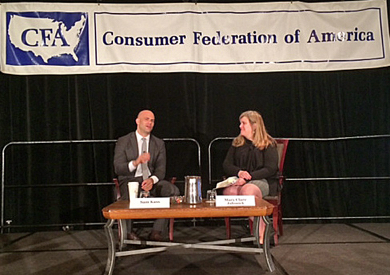 Mary Clare Jalonick of the Associated Press interviews Sam Kass, executive director of “Let's Move,” at the National Food Policy Conference today in Washington. (Jerry Hagstrom/The Hagstrom Report)
The White House kitchen garden has not been certified organic even though a sign reading “organic farming” was on the garden fence on Monday during the Easter Egg Roll, Sam Kass, senior policy adviser on nutrition, told The Hagstrom Report today after he made extensive remarks at the Consumer Federation of America National Food Policy Conference.
Kass is also executive director of First Lady Michelle Obama’s “Let’s Move” initiative and cooks for the Obama family.
The sign “was part of the Easter Egg Roll, not part of the kitchen garden,” Kass explained. The planners of the Easter Egg Roll put up the sign, he said, and he did not see it until he went down to the South Lawn during the event.
In the past, White House officials have said that the first lady, school children and the National Park Service employees who tend the garden use “organic practices,” but do not claim that food from the garden complies with the Agriculture Department’s organic certification program.
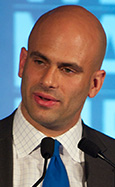
Kass, who graduated from the University of Chicago but went abroad for training as a chef, said during an interview conducted by Mary Clare Jalonick of the Associated Press that he got interested in food issues when he was training in Vienna and the head chef asked him to blend rhubarb with butter.
“They called me Yankee,” Kass said, explaining that the chef asked him to put more and more butter into the rhubarb but finally added more himself, saying “If the guest walks out and drops dead of a heart attack that’s not my problem. They asked me to make the food taste good.”
“That started me thinking about the food I was cooking and what impact it has,” Kass said.
Back in Chicago, Kass worked at the Avec restaurant and operated a private chef service, but became reacquainted with the Obamas, whom he had known when he was in high school, and during the 2008 presidential campaign started cooking for the family.
When then-Sen. Barack Obama won the election and he and Michelle Obama asked him to come to the White House, “It was hard to predict what it meant that he had won.”
Kass said he had dreamed of things he could do with food and nutrition, and that he and Michelle Obama knew “very clearly” that they wanted to plant a kitchen garden at the White House and showcase food and where it is grown.
“We wanted to see how that played and how people responded to it,” he said, adding that he knew the first lady wanted to take on childhood health issues.
While participating in policy discussions, Kass said, his “chef’s hat” is most important in reminding people that the food prepared under the policies the administration has developed has to taste good if the policies are going to succeed.
“Who we are is really defined by what we eat,” he said.
Let’s Move momentum
The Let’s Move campaign against childhood obesity is “in an incredible place,” Kass said. “I’ve never felt so much momentum.”
Developing Let’s Move, he said, involved conversations with “dozens and dozens of experts” to determine where he and the first lady could have an impact, and was “much more complicated than it sounds.”
Michelle Obama’s goal, he said, is that “children born today are going to reach adulthood healthy.”
About 14,000 child care centers are participating in Let’s Move, which means that they don’t serve sugary drinks and must include two hours of physical activity per day. Kass also noted that the food package in the Special Supplemental Nutrition Program for Women, Infants and Children (WIC) has also improved.
“We are getting our kids off to a much better start,” he said.
But the next step, he added, is to address what happens when the child gets home.
“That’s where cooking comes in,” he said, noting the new campaign to encourage more people to prepare meals at home.
Kass said he considers right-wing criticism of Let’s Move and the administration’s campaign for healthier eating to be “an indicator we are having an impact and making a lot of progress.”
“These are complicated issues,” he added. “There is a line and a balance between what is the appropriate role for government in nutrition and food issues. Government has always been engaged in agriculture and nutrition policy from the beginning.”
“Ultimately people have to make a decision for themselves,” he said. “That is how it is and should be. The first lady has always said it is about choice and moderation.”
If people eat properly, they can have a cheeseburger and birthday cake on the weekend, but if people are having birthday cake every night and a cheeseburger every day — “and a lot of people are” — that’s a problem, he said.
Kass said he shares the leftist critics’ “deep sense of urgency” and “it is important to have voices that are trying to speed up progress,” but he does not agree with their view that he and the first lady should not work with the food industry.
The idea “that we could change the food without working with the people who are feeding everybody just doesn’t make any sense to me,” he said.
Child nutrition and school meals
In the administration’s last two years, its officials will have to return to one of its first priorities: reauthorization of the child nutrition programs including WIC and the school meals programs, which were scheduled for reauthorization when Obama came into office and are scheduled for reauthorization again in 2015.
Kass noted that he, the first lady and Agriculture Undersecretary for Food, Nutrition and Consumer Services Kevin Concannon worked hard to see that those programs were improved in what became the 2010 Healthy Hunger-Free Kids Act.
That bill’s provisions to shift all school foods toward less sugar and salt and more whole grains, low fat dairy and meat products and more fruits and vegetables have come under criticism from industry and students, and there are likely to be efforts to repeal some of those provisions during reauthorization.
Asked by Jalonick “how can you improve on what you’ve done,” Kass said, “The key is not going back.” He called the efforts “to undermine the progress that’s been made … disappointing.”
“Plate waste is not up as much as the School Nutrition Association [which represents school food preparers] would like to tell you,” he said, adding that there is “a big divide” between local school providers who are delivering meals according to the new standards and the national leadership of that organization, which has called for changes.
“School chefs are American heroes,” he said. They don’t get a lot of respect, “but they figured out how to implement these policies quicker than we ever dreamed.”
On the nutrition labeling proposal that the Food and Drug Administration has made, he said, “We encourage everybody to comment. It is much more complicated to create a food label than any of you would have thought.”
Kass said he is sure industry doesn’t like all of the proposal, “but they have been supportive.”
He declined to take a position on genetically modified organisms.
“FDA is looking at that,” he said. “It is definitely a contentious and controversial issue. I await to see what FDA does.”
On the proposed ban on trans fats, Kass said that alternatives are being developed and “there is a balance to be struck.” But he added, “We have to get trans fats out of foods, period.”
Riffing on the FDA regulatory phrase that some food additives are “generally recognized as safe,” Kass said that trans fats are “generally recognized as dangerous.” But he also said he wants a way for “small bakers” who have protested the ban on trans fats “to stay in business.”
Kass also declined to comment on whether the system of restaurant menu labeling for calories that was created in the Affordable Care Act will work because it has not been implemented yet. Restaurants, he noted, “want to get some of those calorie counts down” before the program goes into effect.
The future
Kass said he always expected food and nutrition issues to be political because “these are as deep as issues come.”
But he also noted that the first lady has promoted good eating habits through her appearances on popular TV shows and that he believes the food and nutrition debate in some ways is becoming “depoliticized.”
The development of the Agriculture Department’s “My Plate” dietary guidelines program was “a nonpolitical process” in which “we did what we thought was best for consumers.”
He also noted that the administration has said, “enjoy your food, but eat less,” which is the first time the government has said people should eat less.
Kass said that he and the first lady are attempting to “institutionalize” their accomplishments through partnerships with federal agencies and the private sector.
He said he does not know what he will do when he leaves the White House, but that both he and Michelle Obama will remain involved in food and nutrition issues.
“What has been most incredible about my role here in the White House is that I get to touch in a holistic way all the corners of the issue,” Kass said. “We will try to find ways to replicate that. This is the first lady’s life work, this is my life’s work. We are going to keep passionate about that.”
