Vilsack answers senators’ questions on wide range of farm bill issues
May 07, 2014 | 05:04 PM
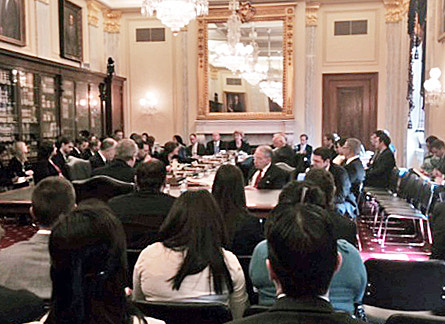 Agriculture Secretary Tom Vilsack, at table left with back to camera, answered questions about the implementation of the farm bill before the Senate Agriculture Committee this morning. (Jerry Hagstrom/The Hagstrom Report)
Everything from the “actively engaged rule” and conservation compliance to the Brazil cotton case and the new position of Agriculture undersecretary for trade came up when Agriculture Secretary Tom Vilsack testified before the Senate Agriculture Committee today on the implementation of the 2014 farm bill.
Here in alphabetical order are discussions of the wide variety of issues that senators raised over the course of the 2½-hour hearing.
Acreage adjustments
In response to a question from Sen. John Walsh, D-Mont., Vilsack said he believes farmers will be able to make adjustments to their acreage and production in their records this fall at their local Farm Service Agency offices.
Actively engaged rule
Sen. Charles Grassley, R-Iowa, said he was disappointed the farm bill did not include stricter requirements on how USDA should define who is an “actively engaged” farmer, and pressed Vilsack for strict implementation of the provision that was included.
Grassley asked if Vilsack agreed that the provision had been used to maximize the amount of farm subsidies people could get, but the secretary would say only “people have been very creative with the law.”
Grassley also said he believes USDA has the authority to define “actively engaged,” but Vilsack said writing that definition “is not an easy task.”
Vilsack noted that the farm bill “really narrows” the authority of the secretary because it tells the secretary not to get involved in family farms and has a “broad” definition of a family farm. Grassley said he still believed that Vilsack could use his “existing authority” to limit the number of farm managers.
Vilsack said that even though USDA’s staff has been reduced, “We are going to take compliance and the integrity of programs very seriously.”
Senate Agriculture Committee Chairwoman Debbie Stabenow, D-Mich., said she wanted to associate herself with Grassley’s remarks.
Bio-based manufacturing
In response to a question from Stabenow, Vilsack said USDA’s rural development division and the National Institute for Food and Agriculture would coordinate research efforts.
Catfish
Vilsack noted to Senate Agriculture Committee ranking member Thad Cochran, R-Miss., that USDA and FDA had signed a memo of understanding on the two agencies’ roles in catfish inspection, and that the rule for the program will go to the Office of Management and Budget in May.
(The National Fisheries Institute said today that the MOU failed to alleviate the duplication of catfish inspection and “ends up highlighting the duplication.” It calls for the two agencies to follow the procedures they use for establishments that produce processed foods involving ingredients such as meat and poultry that come under the jurisdiction of USDA and other ingredients under the FDA.) See link below.
Commodity title and crop insurance
Sen. Pat Roberts, R-Kan., said wheat farmers are worried about whether the Risk Management Agency will have the data needed to develop the new Supplemental Coverage Option crop insurance program this fall, when they are expected to make a choice between the Price Loss Coverage, which allows participation in the SCO program, or the Agriculture Risk Coverage program, which does not.
Vilsack said that while SCO is expected to be available this fall, it will not be before wheat farmers must choose between PLC and ARC, and said that USDA will give wheat farmers an opportunity to reverse the choice if they wish.
Conservation compliance and sod-saver rules
The requirement that farmers who use subsidized crop insurance comply with federal conservation and sod-saver rules went into effect on February 7, Vilsack noted, the day President Barack Obama signed the farm bill.
Most farmers already comply with the rules because they have been participating in commodity programs, but the approximately 6,000 producers for which conservation compliance is new will have until next year to develop a conservation compliance.
Vilsack also told the committee “it would not be good” for farmers to break up land because they would be out of compliance with the sod-saver provision. He later told reporters that farmers who break up native prairie will not get full crop insurance subsidies on that land.
Conservation Reserve Program
In response to questions from Sen. John Thune, R-S.D., Vilsack said he expects the continuous signup for the CRP to resume this spring, but that he is not certain when there will be a general sign-up.
Because the acreage in the CRP will be “constrained,” he said, there is a need to focus on wildlife habitat, pollinators and highly erodible lands.
Cotton program and Brazil cotton case
In response to a question from Cochran, Vilsack said cotton farmers will be able to sign up this summer for the cotton transition program with payments going out this fall, since the new cotton program is not scheduled to go into effect until 2015.
In response to a question from Sen. Saxby Chambliss, R-Ga., Vilsack said USDA officials are “educating” Brazilian officials “that Congress made a good-faith effort” to change the U.S. cotton program to comply with the World Trade Organization panel’s decision that the old program had caused damages to Brazilian cotton growers.
“My hope and belief is that we will continue to work with the Brazilians until we get a resolution,” Vilsack said.
The secretary also assured Chambliss that if Brazil asks for a WTO panel to review the new crop insurance-based cotton program, USDA will defend it.
Dairy program
Vilsack said he hopes to have the new dairy margin insurance program “up and running” in September.
He also told Sen. Pat Leahy, D-Vt., that USDA has money to help dairy farmers learn how to make decisions about the new program.
Endangered Species Act
Vilsack repeatedly urged senators concerned about the ESA listing of the lesser prairie chicken to encourage farmers to work with USDA’s Natural Resources Conservation Service.
“We can provide them 30 years of regulatory certainy,” if farmers sign up for voluntary conservation measures,” he said.
Forest fires
In response to questions from several senators about forest fires and beetle infestations, Vilsack said that the long-term response to those problems depends on developing the new method of financing forest-fire fighting proposed in the president’s budget.
Forest products
Sen. Amy Klobuchar, D-Minn., said she was pleased that forest products can participate in bio-based programs, and Vilsack noted that he wants to encourage the use of forest products for a new wood-based construction material for multi-story buildings.
Foundation for Food and Agriculture Research
USDA has received more than 275 nominations for the 15-member board, Vilsack said, and the foundation, which will raise private funds for agricultural research, is in the process of incorporation.
Vilsack said he expects the board to meet on an ex-officio basis in July.
Healthy Food Financing Initiative
Sen. Kirsten Gillibrand, D-N.Y., said that her state has food deserts from the North Country to the Bronx, and that she wants to make sure money for projects to make food available is spread to all types of communities.
Vilsack said he could commit himself to “pay attention to the deserts wherever they are,” but that it is important for Congress to appropriate money for the initiative, since it was authorized in the farm bill but not given funding.
Nutrition
Chambliss noted that there had been a 24 percent decline in the Emergency Food Assistance Program, but that there were provisions in the farm bill to increase funding for it.
Vilsack also said he is working on a program to provide companies that distribute fruits and vegetables to restaurants with information on how they can donate produce that does not meet the standards required by the restaurants.
Railroad and Waterways study
Klobuchar noted that she had inserted a study on rural transportation issues including rail costs in the farm bill.
Vilsack said that USDA Chief Economist Joe Glauber is already working on the rail transportation study. But Vilsack added he believes it should also include waterways and locks and dams, and that he is working with the Transportation Department to put together enough funding for a comprehensive study.
Vilsack also noted that the BNSF Railway Company has told him it intends to invest $5 billion in rail, locomotives and staff.
Regional conservation partnerships
Several senators asked about this program, and Vilsack said he believes the partnerships can be used in many areas of the country and wants to combine these with his efforts to increase capital and credit availability in rural America.
Trade Promotion Authority
Sen. Mike Johanns, R-Neb., said he was of the opinion that it would be difficult to complete either the Trans-Pacific Partnership negotiations or the Trans-Atlantic Trade and Investment Partnership negotiations unless the president has trade promotion authority, because negotiators in other countries would not want to complete a deal they are not sure Congress will pass.
But Vilsack said that, while these agreements offer “ an enormous opportunity,” there are two ways to look at the process. One is to complete the negotiations and bring them back to Congress and get TPA. The other is to get TPA to complete TTP and T-TIP.
But he added that either way, “I don’t want to underestimate the difficulty.”
Trade undersecretary
Johanns also noted that he had been the initial advocate for the creation of a position of Agriculture undersecretary for trade, which was included in the farm bill, and asked Vilsack if he will meet an August 6 deadline for a report on reorganizing parts of USDA under that undersecretary.
At present, trade responsibilities fall to the undersecretary for farm and foreign agricultural services, and Vilsack said that this reorganization “is a lot more complex than I initially recognized.”
Trade functions exist in agencies throughout USDA, Vilsack noted, raising questions of what should be included in the new undersecretary’s office.
How, for example, do you incorporate the trade role of the Animal and Plant Health Inspection Service?, Vilsack asked.
The secretary said he will try to meet the August 6 deadline but will not meet it if the quality of the report and decision-making would suffer. He also said the process is more difficult because Darci Vetter, the deputy secretary for farm and foreign agricultural services who has handled trade issues, has been nominated to become the chief agriculture trade negotiator and, if confirmed, would move to the Office of the U.S. Trade Representative.
Johanns, who served as Agriculture secretary in the George W. Bush administration and is retiring from the Senate after his term ends this year, noted that 30 farm groups supported the creation of the position.
“Let me use this opportunity to say this is really important,” Johanns said. “I look back at my time at USDA and so much of my time was trade-related.”
Waters of the U.S. rule
Sen. John Hoeven, R-N.D., said farmers are worried about the impact of this Environmental Protection Agency rule on their operations.
Vilsack noted that EPA has already said that normal farming practices will not be impacted, and that he believes the list of those practices will be lengthened.
Young farmers and ranchers insurance reduction
Vilsack told Klobuchar that this provision should be implemented before the end of 2014. He also noted that USDA already announced other resources for young farmers and ranchers.
▪ Statement by Thomas Vilsack before the Senate Committee on Agriculture
▪ Memorandum of Understanding — USDA Food Safety and Inspection Service and Food and Drug Administration
