Cargill explains need for immigrant laborers
July 25, 2014 | 05:24 PM
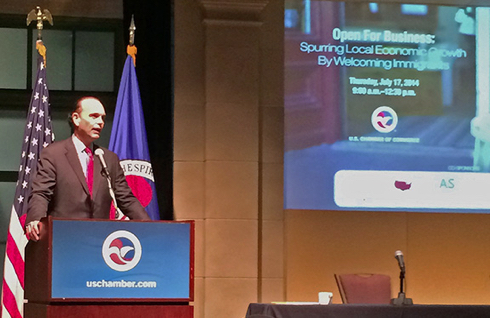
Mike Fernandez, vice president of corporate affairs at Cargill, addresses the U.S. Chamber of Commerce meeting last week in Washington. (Alex Gangitano/The Hagstrom Report)
By ALEX GANGITANO
Cargill Meat Solutions successful employment of immigrant laborers shows the importance of immigration reform legislation, a Cargill executive explained last week at a U.S. Chamber of Commerce event entitled “Open for Business: Spurring Local Economic Growth by Welcoming Immigrants.”

“My intention here is to talk about the politics of immigration reform as well as share some observations, if you will, from America’s heartland about how immigration is making a difference,” said Mike Fernandez, a vice president of corporate affairs, at the July 17 event.
Cargill Meat Solutions is the umbrella organization of Cargill’s North American beef, pork and turkey, foodservice, food distribution businesses.
Fernandez explained that when a Cargill Meat Solutions plant in Ottumwa, Iowa, faced an aging workforce, its managers initially recruited new employees in Texas and California. But today, he said, 40 percent of the plant’s workforce is foreign-born, one in five school children in Ottumwa is Latino and with the support of Cargill, the local high school added soccer teams to support the new residents.
“Our Cargill Meat Solutions general manager, Randy Zorn, prides himself today that many of his managers today are bilingual or multilingual, when they weren’t 10 years ago,” Fernandez said. “All the new Iowans helped Ottumwa reinvigorate the economy.”
“That tale can be repeated and is in many ways being repeated in many places across this land,” he said. “My hope is that the leadership here in Washington can see this in the same way and take something away from your good works. [So we] can finally address immigration in smart ways that not only deal with border security and citizenship, but embrace how important immigration is to our future.”
“Somehow, someway, sometime, we need to start thinking about the next generation and not the next election,” Fernandez said. “Republicans at the minimum should have taken the opportunity to make improvements to the Senate bill. My worst fear is that some of our friends in both major parties have used immigration to show just enough that they care about those of us in this room, so we don’t get overly frustrated.”
Fernandez argued that 10,000 people of the baby boomer generation turn 65 every day and will continue to do so for the next 15 years. He questioned what that will mean for Social Security and the future of employment.
“I ask these questions and share these numbers because I think they’re relevant to the discussions we have been having around immigration,” he said.
“I already said politicians can count, but they also have unanimous support for one thing … every single member of Congress is for a vibrant, competitive economy. They have different means for getting there, but they all believe in a vibrant, competitive economy.”
“The stark reality is that many voters realize what too many politicians do not, that is that immigration is not fundamentally about border control or citizenship, its about economics,” he said.
Many immigrants “would go home at least periodically if they knew they could come back,” he said. “Some of us are staring at the border and others of us are staring at the flag.”
“We need integrated efforts — government, law enforcement, churches, businesses … —working hand-and-hand to not only demonstrate more grace, compassion and thoughtfulness, all of which this issue requires, but to help us play even additional angles to support a more vibrant economy,” Fernandez concluded.
