Analyst: Sugar growers probably will win cases against Mexico
August 05, 2014 | 07:18 PM
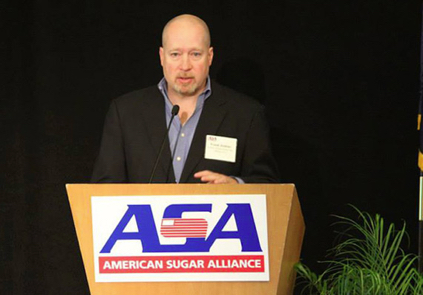 Frank Jenkins of the Jenkins Sugar Group addresses the American Sugar Alliance Sweetener Symposium in Stowe, Vt., (American Sugar Alliance)
STOWE, Vt. — U.S. sugar growers are likely to win the antidumping and countervailing duty cases against the Mexican sugar industry that they filed with the Commerce Department and the International Trade Commission, a key sugar analyst said here this week at the American Sugar Alliance annual International Sweetener Symposium.
During a panel on U.S. and world sweetener market outlook, Frank Jenkins, a sugar analyst based in Wilton, Conn., said that “in the past two years USDA has lost its ability to manage the U.S. sugar program.”
Jenkins blamed large Mexican exports to the United States for the difficulty in managing the sugar program, but said he believes the market will become “manageable” again after the cases that the growers have brought against the Mexican industries are resolved.
The imports from Mexico have raised havoc with the sugar program, which functioned for years with almost no expenditures by the government.
Under the U.S. farm bill, the Agriculture Department is supposed to manage the sugar market so that prices stay above the levels at which farmers can forfeit sugar to the government.
For decades USDA achieved that by controlling imports, but the North American Free Trade Agreement gave Mexico full access to the U.S. market. NAFTA does not, however, allow Mexico to send the subsidized exports to the United States.
After massive increases in Mexican imports, U.S. sugar prices fell below forfeiture levels and this year the U.S. government had to make payments of $278 million to growers for their sugar. The growers have always described their program as operating at no net cost to the taxpayer, so the payments have raised questions about the long-term political viability of the program.
Jack Roney, the ASA’s chief economist, noted, however, that despite the payment this year, sugar is still the least expensive U.S. commodity program.
Earlier this year, the growers asked the International Trade Commission to institute antidumping and countervailing duties on sugar imports from Mexico on the grounds that Mexico had dumped the sugar in the United States and that it is subsidizing the industry through a range of actions, including tax and interest forgiveness.
In a followup interview, Jenkins told The Hagstrom Report that he believes the U.S. sugar growers have "put together a pretty solid case.”
He described the Mexican market as "two-tiered," with domestic sales and a "higher level of exports that suggests that there has been dumping going on.”
He also said the way the U.S. growers have detailed the situation in their cases, with the Mexican government engaging in forgiveness of debts, indicates that the Mexican industry has been receiving assistance from its government.
An ASA spokesman said that the loans the Mexican industry had gotten from its government were preferential, and that there had also been grants.
Jenkins said that because Mexico is not exporting to the United States at the present time he believes that “we are moving back to USDA being able to control the situation.” The cases, he said, are “disruptive and overhanging the market,” but that he does not expect the cases to be resolved before January.
Other attendees at the conference said that they do not believe that the cases will be completed because the U.S. and Mexican governments will reach some kind of agreement before the cases reach final resolution. The U.S. Sweetener Users Association has said that it is afraid that U.S. and Mexican officials will attempt to manage the markets.

Randy Green, a consultant to the Sweeteners Users Association, which opposes the growers’s case, disagreed that imports from Mexico are responsible for USDA’s difficulties in managing the U.S. sugar market.
“Mexico is a vital part of the U.S. sugar supply and has been since the implementation of the North America Free Trade Agreement,” said Green.
“And while over the years U.S. imports of Mexican sugar have increased, they have increased at the expense of [tariff rate quota] imports, not domestic production. This is a key point that leads to the question: What has caused the fluctuations in the U.S. market if not Mexican sugar? Put simply, the U.S. sugar program.”
Green maintained that high prices in the United States due to the existence of the sugar program have been an incentive for increased output in both Mexico and the United States, and have resulted in sugar surpluses and low prices.
“This fluctuation in prices and supply over the past several years is not a sinister plot by Mexico, but rather the ramifications of an outdated, protectionist U.S. sugar program that is in need of reform,” Green said.
Congress, he said, should make a number of changes in the sugar program, although that seems unlikely since the 2014 farm bill has reauthorized the sugar program through 2018.

Barbara Fecso, who manages the sugar program for USDA’s Farm Service Agency, said USDA officials have been doing their best to achieve balance between the growers and the users, but that it has been difficult because the Mexican imports have been so unpredictable.
The legal cases apparently kept any Mexican government or industry officials from appearing on the Sweetener Symposium program, but Fecso said the Mexicans note that they supplied the U.S. market when there were shortages and last year shipped sugar to other parts of the world.
The Mexicans, Fecso said, ask “ ‘Why is everybody mad at us? How can you blame us for expanding production?’ ”
Other analysts and industry executives at the meeting agreed that the world remains awash in sugar.

José Orive, executive director of the International Sugar Organization in London, noted that world supply had exceeded demand for four years.
Orive said, however, that he believes the sugar surplus will end in 2014-2015 and that long-term the world will need more sugar than is currently being produced.
Patrick Chatenay, founder of ProSunergy Ltd., a Canterbury, U.K., firm, said today he still believes it will take several years for the market to improve.
He also emphasized that Brazil subsidies its sugar industry and that China, India and Thailand want to increase sugar production.
“Subsidies are rampant, they are unequal and they are growing,” Chatenay said.
