Whole-Farm Revenue Protection crop insurance available
November 10, 2014 | 05:34 PM
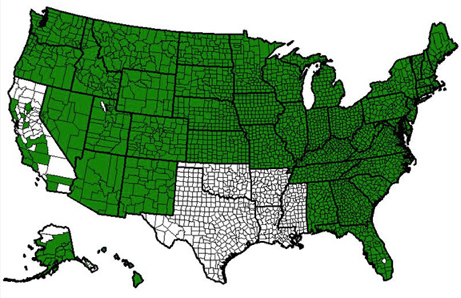
The Whole-Farm Revenue Protection pilot program is available in most of the United States (green areas), except Arkansas, Louisiana, Mississippi, Oklahoma and Texas. It is available in 15 California counties — Butte, Fresno, Kern, Mendocino, Monterey, Riverside, San Diego, San Joaquin, San Luis Obispo, Santa Barbara, Sonoma, Tulare, Ventura, Yuba and Yolo — and in all of Alaska except North Slope and Northwest Arctic counties. (USDA-Risk Management Agency)
Whole-Farm Revenue Protection crop insurance policies that will be of particular interest to fruit and vegetable growers and organic farmers and ranchers is now available for the 2015 crop year in almost all parts of the country, the Agriculture Department announced late last week.
The policy allows producers to insure between 50 to 85 percent of their whole-farm revenue by insuring a variety of crops at once instead of one commodity at a time. That gives them the option of embracing more crop diversity and helps support the production of a wider variety of foods, USDA’s Risk Management Agency said in a news release.
Whole-Farm Revenue Protection is tailored for any farm with up to $8.5 million in insured revenue, including farms with specialty or organic commodities (both crops and livestock), or those marketing to local, regional, farm-identity preserved, specialty, or direct markets, RMA added.
The new policy will also provide a whole-farm premium subsidy to farms with two or more commodities as long as minimum diversification requirements are met, which means purchasing crop insurance will be more affordable for producers, the agency said. Whole-Farm Revenue Protection can be purchased in conjunction with individual crop policies as long as those policies are at a buy-up coverage level.
Many of the farmers who are likely to purchase the Whole-Farm Revenue Protection have not bought insurance before, RMA Administrator Brandon Willis said in an interview.
“This levels the playing field for producers who felt that crop insurance didn’t work for them,” Willis said.
If they buy 75 percent coverage, they will pay 25 percent less than under the previous Adjusted Gross Revenue and AGR-lite policies, he added. Farmers will buy the policies through crop insurance agents and their coverage levels will depend on their last five years of tax records, he said.
The Whole-Farm Revenue Protection Program is available in 45 states.
But it is available in only part of Alaska and California and is not available in the south Central states of Arkansas, Louisiana, Mississippi, Oklahoma and Texas because they were not similar enough to the existing Adjusted Gross Revenue and Adjusted Gross Revenue-Lite program areas for accurate underwriting and actuarial work to be completed for 2015.
An RMA spokesman said that expansion to these areas will be considered when underwriting can be completed in future insurance years.
Additional underwriting work will include the identification of:
- Similar risk areas,
- What commodities are grown in each risk area,
- What data are available for actuarial work, and
- Risks specific to the risk areas, along with the completion of all of the necessary actuarial work.
“The release of this new whole-farm policy levels the playing field for diversified sustainable and organic farmers,” said Paul Wolfe, policy analyst for the National Sustainable Agriculture Coalition.
“Farmers that grow crops that are uninsurable under any other policy and those who cannot insure their organic or niche market crop for its true value now have what we hope is a very viable insurance option.”
For the first time, farmers in eight states, including Iowa, Indiana, Kentucky, Missouri, Nebraska, North Dakota, Ohio and South Dakota, will be able insure their entire farm revenue with one policy, NSAC said.
▪ USDA Risk Management Agency — Whole-Farm Revenue Protection for Federal Crop Insurance: Pilot Policy
▪ — Fact Sheet
