Roberts talks politics to NASDA
February 03, 2015 |04:19 PM
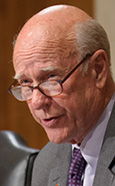
Senate Agriculture Committee Chairman Pat Roberts, R-Kan., used most of his speech to the National Association of State Departments of Agriculture today to explain where he thinks the nation stands politically.
Roberts said he thinks the results of the 2014 election, in which he won re-election and the Republicans won control of the Senate, was a result of the voters being tired of gridlock.
People were tired of governance by executive orders and regulation, Roberts said., adding that too much regulation signals that government doesn’t trust the people, he said.
“If you don’t trust people, in turn people don’t trust the government,” he added. “That is the issue facing the country.”
Although Congress did pass the farm bill in 2014, Roberts said that gridlock makes the committees irrelevant.
Roberts devoted most of his attention to two matters over which the Senate Agriculture Committee does not have direct jurisdiction: the Endangered Species Act, administered by the Interior Department, and the Waters of the United States (WOTUS) rule, a project of the Environmental Protection Agency and the U.S. Army Corps of Engineers.
Referring to issue of whether the lesser prairie chicken should be considered endangered, Roberts maintained that their numbers have gone down because there has been a drought, and said now that it has begun to rain in Kansas, the habitat will improve and so will the bird numbers.
He said he wishes Interior would get back to its original purpose of providing for conservation and enough habitat for birds and animals to exist, and “not get so hung up on listing every creature known to mankind.”
On WOTUS, Roberts warned the agriculture commissioners that agriculture needs to tell its story carefully.
“You don’t want to get into an argument about clean water,” Roberts said. “You will lose that argument.”
Roberts also said he is opposed the provision in President Barack Obama’s budget that would repeal the stepped-up basis that farmers and ranchers use in passing their estates on to their heirs.
He said he would in favor of repealing the estate tax, which he calls the “death tax,” rather than increasing those taxes. Repealing the stepped-up basis would make it difficult for farmers to pass their main assets to their children, raise the cost of capital and create complexity, he said.
Roberts said he has been meeting with members of his committee and that the committee will have three goals:
- To be the “champion of farmers, ranchers and small business,”
- To conduct rigorous oversight of the agencies under its jurisdiction, and
- To work under regular order to reauthorize the child nutrition programs, the federal livestock marketing program and the Commodity Exchange Act, which covers the Commodity Futures Trading Commission.
Roberts also said he is considering having “those with mud on their boots” testify ahead of USDA officials, because the officials always ask for more money.
Roberts said afterward that he will invite Agriculture Secretary Tom Vilsack to testify before the committee.
Asked whether budget reconciliation might lead to a cut in crop insurance or the commodity title, Roberts said only, “ We’ll have to meet our budget responsibilities.”
Roberts also noted that an unrelated group called CATS was meeting next door to NASDA. Roberts said he thought perhaps it was the House Conservative Action Team, but then decided it wasn’t because “nothing exploded.”
