Beyond the USA Pavilion at Expo Milano
July 03, 2015 |12:15 AM
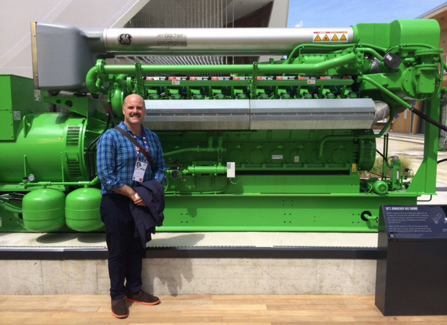 Mitchell Davis, USA Pavilion creative director, stands in front of the Jenbacher, GE Power & Water’s gas engine that generates power from biofuel made from farm and landfill waste. The company says there are 3,700 Jenbachers in the world, turning such materials as sugarcane compost, manure and brewery hops waste into enough electricity to serve 5.5 million homes each year,. USA Pavilion officials said they asked to use the Jenbacher to generate power at the pavilion, but the expo would not allow it. (Jerry Hagstrom/The Hagstrom Report)
By JERRY HAGSTROM
People who visit their own country’s pavilion at Expo Milano are unlikely to learn much new about their own food or agriculture, but they are likely to learn a lot from the other pavilions.
One day at the expo is not enough to even half of it, and there are multi-day passes available on the website.
Here are some observations of other pavilions:
— The entryway of the French pavilion has a beautiful display of crops that should be a revelation to people who drive by fields and wonder what is growing. But the inside exhibition of foods from each region of France is not very interesting.
— The Russian pavilion, designed to resemble Noah’s Ark, has a great exhibition on a plant breeder I never heard of. He seems to be the Russian equivalent of Henry Wallace (founder of Pioneer Hi-Bred, FDR’s agriculture secretary, and later vice president), but I didn’t write his name down.
— Nestlé has an exhibition that begins with a fetus “eating” in the womb.
— The Italian Dairy Federation’s exhibition features an artwork of the baby Jesus with his hand on the breast of Mary, as well as other artworks of Jesus suckling.
— Lines were long at the Italian, German and Japanese exhibitions, which may signal that those are worth waiting for, but the wait to get in was so long I did not enter them.
— The Chilean exhibition has great, quick food, including a sandwich of steak and avocado.
— New Holland has the only exhibition of farm equipment and serves Prosecco, the Italian white sparkling wine, raising the question of whether John Deere will have to start serving at least beer at its trade shows.
— Argentina has an extraordinary movie depicting Italian immigration to that country on multiple screens. Its restaurant has some the longest lines, perhaps because is serves “asado” at fairly low prices and the smell of the grilled meat lures people in.
— Vanke, a Chinese real estate company, has a video showing the importance of the canteen in Chinese society, from ancient times to the present as the people move to the city and need a place to meet. The video is shown on multiple small screens at the same time, and the screens are hung on bamboo.
— There are no live animals at Expo Milano, raising the question of whether the expo is focused on the current fashion of a plant-based diet or whether the organizers didn’t want to deal with manure or odors.
— There are countries missing, such as Canada and the Scandinavian nations. Meanwhile the relatively small countries of Slovenia and Slovakia have two of the showiest exhibits.
— There are so many European “big agriculture” exhibits that no one should pay attention to a European saying that Europe is better for small-scale agriculture than the United States.
— The slow food movement may have started in Italy and be based here, but the Slow Food exhibit is at the farthest end of the expo.
If you haven’t planned a summer vacation yet, or want a fall vacation or business trip, consider buying a plane ticket to Milan for Expo Milano 2015: Feeding the Planet, Energy for Life.
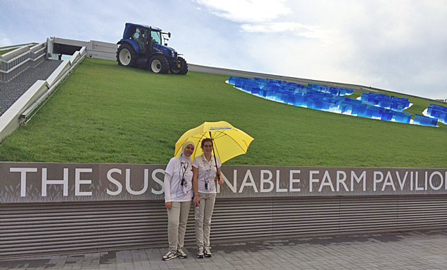 New Holland’s pavilion, the only one to show farm equipment, has a grass roof. The pavilion is designed to show how the company is preparing for a more sustainable future in farming. “Given the right technologies to create their own bioenergy, farmers can be freed from the constraints of fossil fuels,” the company’s website says. (Jerry Hagstrom/The Hagstrom Report)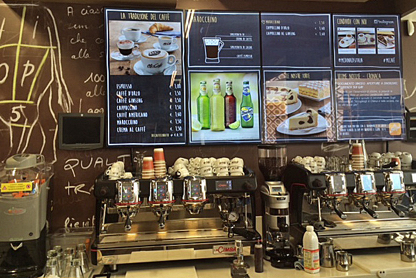
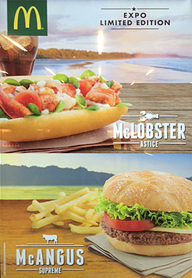
Left: The McDonald’s pavilion has a coffee bar that serves Italian desserts. The company has launched a “Fattore Futuro” project to support young Italian farmers interested in innovation and sustainability. Right: McDonald’s is serving “limited edition" “McLobster” rolls and “McAngus” sandwiches as part of its regular menu at the Expo.
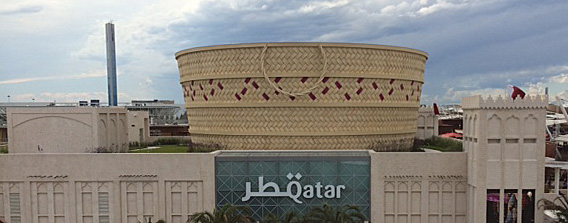
The architecture of the Qatar pavilion recalls the traditional market – the souq – with a circular structure at the center reminiscent of the traditional food basket – the jefeer – “symbolizing the interweaving of local dimensions and global innovation which characterizes Qatar.” (Jerry Hagstrom/The Hagstrom Report)
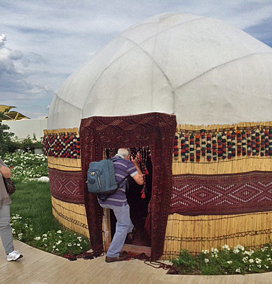
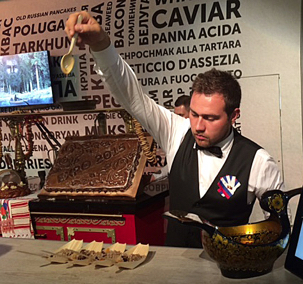
Left: A traditional yurt is featured on the rooftop of the Turkmenistan pavilion, decorated inside with handmade turkmen carpets. Right: At the Russian Federation pavilion, a waiter makes a show of drizzling honey over a porridge made of barley. Traditional Russian food is offered at the pavilion’s show kitchen, and free tastings of traditional drinks are offered daily.(Jerry Hagstrom/The Hagstrom Report)
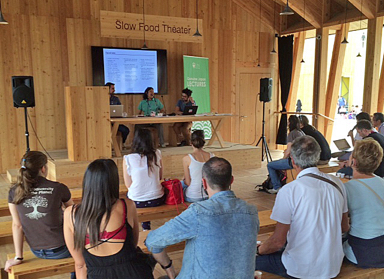
The Slow Food pavilion is at the very end of the expo. Here, in the Slow Food Theater, visitors are listening to a lecture on how to taste Japanese sake. The organization is focused on the issue of biodiversity and providing “good, clean and fair food.” (Jerry Hagstrom/The Hagstrom Report)
