Government, industry react to Tulane study showing more children working in cocoa production
August 12, 2015 |06:59 PM
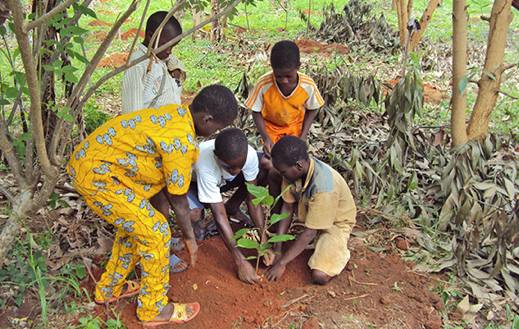
Children planting a cocoa tree in West Africa. (World Cocoa Foundation)
U.S. policy makers and cocoa and chocolate industry executives are trying to figure out how to proceed on the goal of reducing the number of children working in cocoa production in West Africa, following the release last week of a Labor Department-commissioned report that found the number of children doing hazardous work in cocoa production grew between 2008 and 2014, despite efforts by governments and private groups to reduce their numbers.
The report, published by the Tulane University School of Public Health and Tropical Medicine, estimates that in the 2013-14 production season, there were 2.12 million children laboring in cocoa production in West Africa, an increase of 360,000 or 16 percent from 2008-2009.
Of that number, the study said, 2.03 million children were involved in hazardous work, an increase of 310,000 or 13 percent.
The increases were in the Ivory Coast (Côte d’Ivoire), the world’s leading cocoa producer, which experienced large growth in cocoa production. In neighboring Ghana, which produces about half as much cocoa, the number of children working in cocoa production and performing hazardous tasks fell, but by less than 6 percent.
On the positive side, the study did find that the number of children exposed to multiple hazards such as carrying heavy loads and working with sharp tools fell, and that the percentage of children working in cocoa who attend school rose from 59 percent to 71 percent in Ivory Coast and from 91 percent to 96 percent in Ghana.
But overall the study was disappointing to public and industry officials who have been trying to improve the lot of the children since 2001, when media reports highlighted child trafficking and other labor abuses in West African cocoa production.
The International Labor Organization, a U.N. agency, considers some tasks in cocoa production among “the worst forms of child labor.”
As the Labor Department’s Bureau of International Labor Affairs website describes the situation, “Children working in cocoa may work long hours, carry heavy loads, and use dangerous tools. Children may also be involved in spraying cocoa trees with pesticides or burning fields to clear them.”
Those 2001 media reports led to the establishment of what’s known as the Harkin-Engel Protocol, named for then-Sen. Tom Harkin, D-Iowa, and Rep. Eliot Engel, D-N.Y.
Under Harkin-Engel, the international chocolate and cocoa industry made commitments to reducing child labor.
In 2010, in an elaborate ceremony in Washington, then-Labor Secretary Hilda Solis, representatives of the governments of the Ivory Coast and Ghana, the International Labor Organization and the chocolate and cocoa industry represented by Lawrence Graham, then president of the National Confectioners Association, signed a declaration of joint action to take steps that were supposed to reduce the worst forms of child labor in the cocoa sector as defined by the International Labor Organization by 70 percent by 2020.
The Tulane report, which was part of the Labor Department’s promise to monitor the situation, said that to achieve the reduction target 1.5 million children would have to be removed from hazardous cocoa work by 2020.
“Production methods and/or child labor mitigation strategies need to change drastically to achieve major progress.,” the report said, adding that the Harkin-Engel Protocol remains important for setting a focus to achieve the goal.
The report recommended
- a continuing commitment of financial and other resources by all stakeholders.
- financially sustainable interventions targeted to cover a large number of children.
- construction of schools in rural areas and maintenance of schools.
- better access to protective clothing, basic safety equipment and safety training.
- mechanization of the cocoa sector.
- treating Ivory Coast and Ghana separately with different targets for each country.
Complicated situation
Reactions from public and industry officials reflected the fact that the root causes of child labor in West African cocoa production are complicated.
Cocoa is native to South America, but was introduced in Africa in the colonial era, and 70 percent of world production comes from Ivory Coast and Ghana. Most cocoa farmers are smallholders, and African children have helped their parents raise cocoa for generations.
Today worldwide demand for chocolate is increasing as developing countries get richer, and the bigger market also creates the need for more labor.
The Tulane report acknowledged that the challenge of reducing child labor in cocoa is “increased by trends outside of the direct control of the stakeholders involved in the fight against child labor.”
The report noted the research took place amidst a period of political violence in Ivory Coast that disrupted schools and general economic progress in Ghana.
There was a 40 percent increase in cocoa production in Ivory Coast and a 30 percent increase in Ghana between the 2008-2009 harvest season and the 2013-2014 season.
Engel said in an email, “As the report tells us, we still have a long way to go to get children out of harm’s way in Ghana and Côte d’Ivoire. We should accelerate our efforts across the U.S. government, and we should also make sure we’re working hand-in-hand with those countries to put their action plans in place and make a difference for their children.”
Labor Secretary Thomas Perez announced last week that DOL’s Bureau of International Labor Affairs is making $12 million in funding for three new grants to advance its efforts on this issue — $4.5 million for education in Ivory Coast, $4.5 million for at-risk youth to develop marketable skills in Ghana, and $3 million to continue assessing the situation, including a child labor survey and a map of geographic areas and communities that have been the recipient of interventions to address child labor in cocoa.

Perez also announced the availability of another $4.87 million for one or more cooperative agreements to implement the Agriculture Department’s Guidelines for Eliminating Child and Forced Labor in Agricultural Supply Chains.
“While progress has been made, we know that much work remains to be done,” Perez said in a news release.
“There is an urgent need to find new ways for accelerating, scaling up and sustaining progress on child labor in cocoa. Time is not on our side. Childhoods — and with them the opportunity for quality education and a better life — fade with every passing season.”
“The challenges remain substantial,” added Eric Biel, the Labor associate deputy undersecretary for international affairs, in a blog post. “Child labor is linked to broader issues like a lack of access to quality education and a persistent cycle of poverty.”
Biel also noted that Ivory Coast government, with the leadership of First Lady Dominique Ouattara, has increased its budget for combating child labor and drafted a law making education compulsory up to the age of 16.
Ghana, he said, signed a compact with the United States to find more effective policies and programs to reduce child trafficking and protect children from exploitation.

The World Cocoa Foundation, an industry group established in 2000 to work with cocoa farmers on a range of issues, said its member companies are “deeply concerned that the collective efforts undertaken thus far by the cocoa and chocolate industry, the United States government, the governments of Ghana and Côte d'Ivoire, and others, have not been sufficient to achieve significant reductions in the number of children working in unacceptable conditions in West Africa, often in circumstances defined as child labor.”
“Reducing the number of children participating in child labor is a shared responsibility of industry, governments, NGOs, civil society, communities and families, among others, and remains a top priority for WCF and our member companies,” the foundation said.
World Cocoa Foundation President Bill Guyton noted in an interview that member companies that buy chocolate work with farmers to improve their productivity and profits, and they believe that farmers whose livelihoods improve are more likely to send their children to school rather than put them to work.
Eleven of the World Cocoa Foundation’s largest companies including ADM, Cargill, Hershey, Mars, Mondelēz International and Nestlé joined Cocoa Action, a World Cocoa Foundation strategy started in 2014 to provide 300,000 farmers in the Ivory Coast and Ghana better fertilizer and planting material and to promote education and gender empowerment for women.
“Professionalizing” the farmers, Guyton said, “will improve their incomes, which will enable them to hire labor rather than use child labor.”
But Guyton also noted that the industry cannot reduce child labor on its own. The governments in the Ivory Coast and Ghana must provide schools for the children to attend, he said.

Many of the same companies also belong to the International Cocoa Initiative, a Geneva-based group that focuses on schooling, vocational training and community issues such as health, water and sanitation in cocoa-producing areas.
“This is a rallying call for everyone to do more, to do it better, and to do it together,” says Nick Weatherill, ICI’s executive director, in a news release.
“We know that our community child protection model has a significant impact, but it needs to be scaled up to reach many more farming communities, and it also needs to be matched with supportive government policies and actions in both countries.”
Cocoa and chocolate companies are also worried about consumer reaction. As one company representative said, the situation is one of “reputational risk. It is easy for things to be stated without understanding what the full situation is.”
Many companies, the company representative noted, have signed up for certification programs to reassure consumers.
Consumer concern about chocolate does seem to be growing. Fairtrade International, a group that certifies farmers have received a fair price for the ingredients in the products it endorses, said in an email that its cocoa imports to the United States rose by 42 percent between 2013 and 2014. Fair trade still makes up only 1 percent of U.S. chocolate sales, however.
Individual chocolate companies have also set up their own programs to reduce child labor and enhance sustainability in general.
Nestlé has its own cocoa plan and has committed itself to reducing child labor as part of “creating shared value” strategy. The company said it would use the report’s findings “to reinforce its efforts to eliminate child labor in its cocoa supply chain.”
Nestlé is helping cocoa farmers form cooperatives, but two Fair Labor Association reports on Nestlé’s efforts said that the plan supplied only 20 percent of the company’s cocoa and proposed a wide range of actions for the company to undertake to improve.
Cocoa and chocolate companies see the reduction in child labor as part of a broader strategy to assure itself of a future supply of ingredients.
Mondelēz International, for example, says on its web site, “Demand for chocolate is growing, especially in emerging markets. But cocoa supply is constrained by a complex range of technical, environmental and socio-economic issues. We want to help maintain the long-term stability of the cocoa supply chain and improve the welfare of cocoa farmers and their communities.”
Mondelēz has set up Cocoa Life, an effort to work with cocoa farmers to improve farming methods. The company said in a statement that it is “concerned by the increase in cases of child labor in West African cocoa-growing regions,” but emphasized it is trying to address the issue through both CocoaAction and the International Cocoa Initiative.
Cocoa Life will invest $400 million by 2022 to empower 200,000 cocoa farmers and reach 1 million community members, not only in Ivory Coast and Ghana, but Indonesia, India, the Dominican Republic and Brazil.
Mondelēz also noted it has commissioned Embode, a human rights consulting agency, to identify additional measures to tackle child labor in West Africa and that its efforts will be evaluated by an independent team of researchers from Harvard University.
Mondelēz also said, however, that “it is not our place to decide what the right level of income is for cocoa farmers. With Cocoa Life we want to empower cocoa farmers: enable them and their communities to set their development path, equip them with the agricultural and business know-how, and provide a more direct access to the market.”
Exactly how the right price level for cocoa can be set is difficult to determine, however.

Elan Emanuel, senior cocoa supply chain manager at Fair Trade USA, said in an email that “like many global issues, poverty is the primary root cause of child labor. And unless NGOs and industry strive to change the economics of cocoa farming, where today farmers earn abysmally low wages and are stuck in deep cycles of poverty, child labor will likely persist.”
“How much a cocoa farmer earns, which can be around 25 cents a day in West Africa, is directly linked to their ability to pay for school tuition and school supplies, hire adult workers, and invest in safer, more sustainable practices,” Emanuel said.
“Today West African cocoa farmers also face challenges like aging trees and low productivity, but they don’t have enough money to invest in their farms and command higher prices in the long term.”
Emanuel said that under Fair Trade’s system, farmers receive a “community development premium” they can spend on school tuition, wells for clean drinking water, and in some cases entirely new schools, or for fertilizer and seedlings to increase the productivity of their farms.
“Fair Trade does not simply aim to prohibit child labor, it aims to eliminate reliance on child labor by making cocoa farming a viable profession for generations to come,” Emanuel said.

While the government officials and industry groups were not critical of anyone, the Child Labor Coalition, whose members include the National Consumers League and the American Federation of Teachers, said that even though the study found more children attending school in both countries, "there seems to be little progress in removing children from cocoa farms, and in the Cote d’Ivoire, the numbers have gotten much worse with 48 percent more children involved in child labor in cocoa and 46 percent more involved in hazardous labor in cocoa.”
“In Ghana, there seemed to be slight progress in the numbers of children in child labor as well as children performing hazardous work in cocoa production, but it’s clear that greater progress must be made here too,” the coalition said.
“The chocolate companies that benefit from the labor of children and adults on cocoa farms must do more to combat child labor,” said Reid Maki, who coordinates the coalition.
“They must contribute more resources into the sector and identify new strategies to remediate child labor, including mechanisms that secure better prices for farmers who must then improve wages for adult farmworkers so they do not feel compelled to use the labor of children,” Maki said.
“Unionization and farmer cooperatives are also important keys to solving this problem. Solving this difficult problem will mean finding a solution in which in which workers have greater voice in determining their livelihoods. Continued progress in getting children into schools will be another important key in solving the child labor problem.”
- Tulane University — 2013/14 Survey Research on Child Labor in West African Cocoa Growing Areas
- — Summary
- Harkin-Engel Protocol
- Labor Department Bureau of International Labor Affairs — Child Labor in the Production of Cocoa
- World Cocoa Foundation
- International Cocoa Initiative
- Fairtrade International
- Child Labor Coalition
- Fair Trade USA
