World crop insurance leaders meet in U.S.
October 02, 2015 |01:14 PM
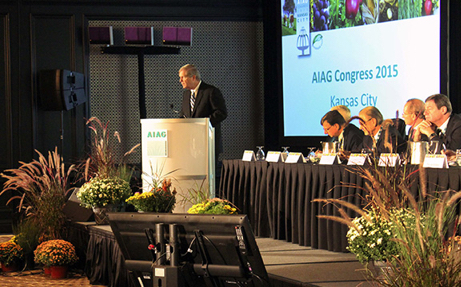
The International Association of Agricultural Production Insurers board of directors listens to Agriculture Secretary Tom Vilsack’s keystone address at last week’s conference in Kansas City. (USDA/Greg Batson)
KANSAS CITY — Crop insurance executives from 31 countries gathered here this week for the first meeting of International Association of Agricultural Production Insurers (AIAG) held in the United States.
The meeting, held Monday to Wednesday, was hosted by National Crop Insurance Services and the Rain and Hail insurance company. NCIS President Tom Zacharias explained that Kansas City was chosen as the location because so many institutions important to agriculture are located there.
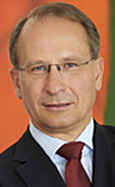
Explaining why the AIAG had decided to meet outside Europe for the first time, President Kurt Weinberger noted that “the U.S. crop insurance system and the U.S. public-private partnership are the most developed systems in the world. The agricultural insurance sector must learn from the world’s best.”
A map in the conference program confirmed Weinberger’s statement. Of the $28.4 billion in crop insurance premiums worldwide in 2014, $12.2 billion were paid in the United States and Canada, $9.4 billion in Asia, $4.8 billion in the Europe-Africa-Middle East region and $2 billion in Latin America.
Noting that farming faces more challenges than ever due to climate change and the political reaction to it, Weinberger said, “It has seldom been more important than now to think about more income security for farmers.”
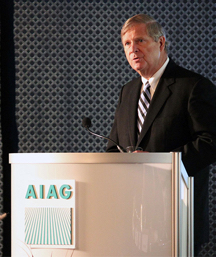
Agricultural Secretary Tom Vilsack addresses the International Association of Agricultural Production Insurers in Kansas City. (USDA/Greg Batson)
Agriculture Secretary Tom Vilsack said in a keynote speech that agriculture has become 12 times more productive since he was born in 1950, but “farmers around the world have faced record droughts, ice storms, blizzards.”
“In the wake of a devastating disaster crop insurance offers a life line to producers,” he said.
Vilsack recalled that early in his tenure as secretary he visited a farm in upstate New York that had been subject to a hurricane, and farmers were worried they would lose their farms. He also visited farms in Mississippi and the Carolinas, but crop insurance covered their crops and they were not nearly as worried.
The 2014 farm bill continued the expansion of the farm safety net, including crop insurance for fruit and vegetable producers.
USDA’s Risk Management Agency is often approached by other countries for advice on how to implement crop insurance — most recently Mongolia — and will continue to provide that advice, Vilsack said.
In response to a question from Lambert Muhr of Munich Re, a reinsurer, Vilsack explained that the United States had gotten rid of the direct payments that are similar to the payments that European farmers receive because taxpayers objected to the fact that farmers got the payments whether prices were high or low.
“The relationship between producers and taxpayers is a complicated one,” Vilsack said.
“Because so many Americans have been two, three, four generations removed from farming, there may not be a full appreciation of where food comes from and how it is produced.
“They may not understand why there needs to be a safety net. What folks don’t understand is that farmers can be the best in the world at what they do, but can still end up without a single kernel of corn.”
“But taxpayers do understand insurance,” Vilsack noted. “There’s auto insurance, there is home insurance.”
The fact that farmers pay part of the insurance premium and that payments are made only when farmers are troubled by weather risks or low prices “is much more defensible from a political standpoint. People get that,” Vilsack said.
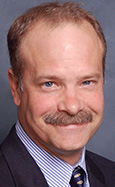
Stephen Frerichs, a crop insurance consultant and former Office of Management and Budget official, explained the political evolution of the crop insurance program from the 1930s to the present.
In the 2014 farm bill, the crop insurance industry accepted the inclusion of a conservation compliance provision as eligibility for crop insurance premium subsidies rather than cuts to the program or means tests for subsidies, he noted.
“There is a lot of horse trading,” Frerichs said, as attendees listened for ideas on how to establish or expand crop insurance in other countries.
